
The Silo’s under the last ‘super’ moon…
Rangitoto Echo
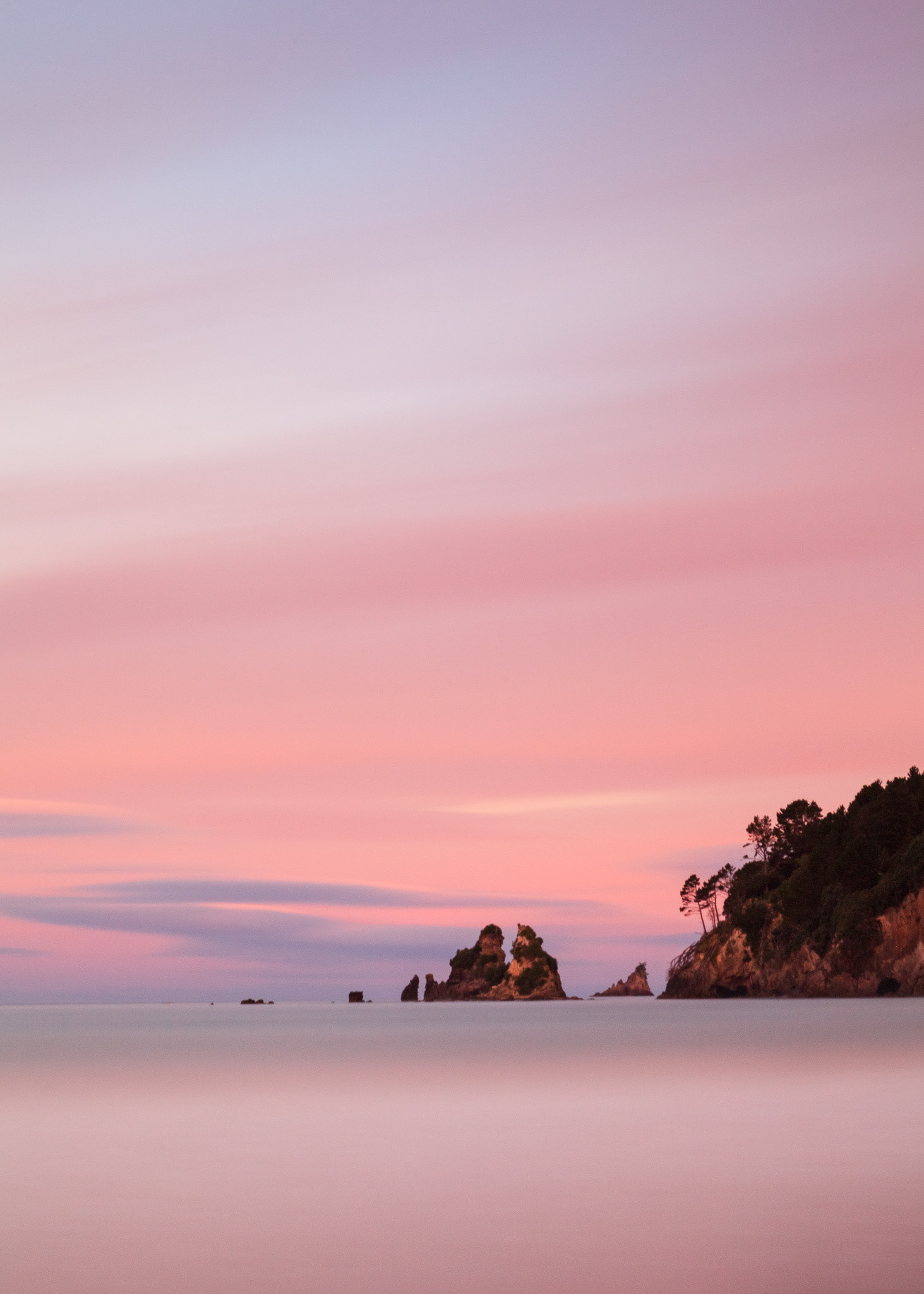
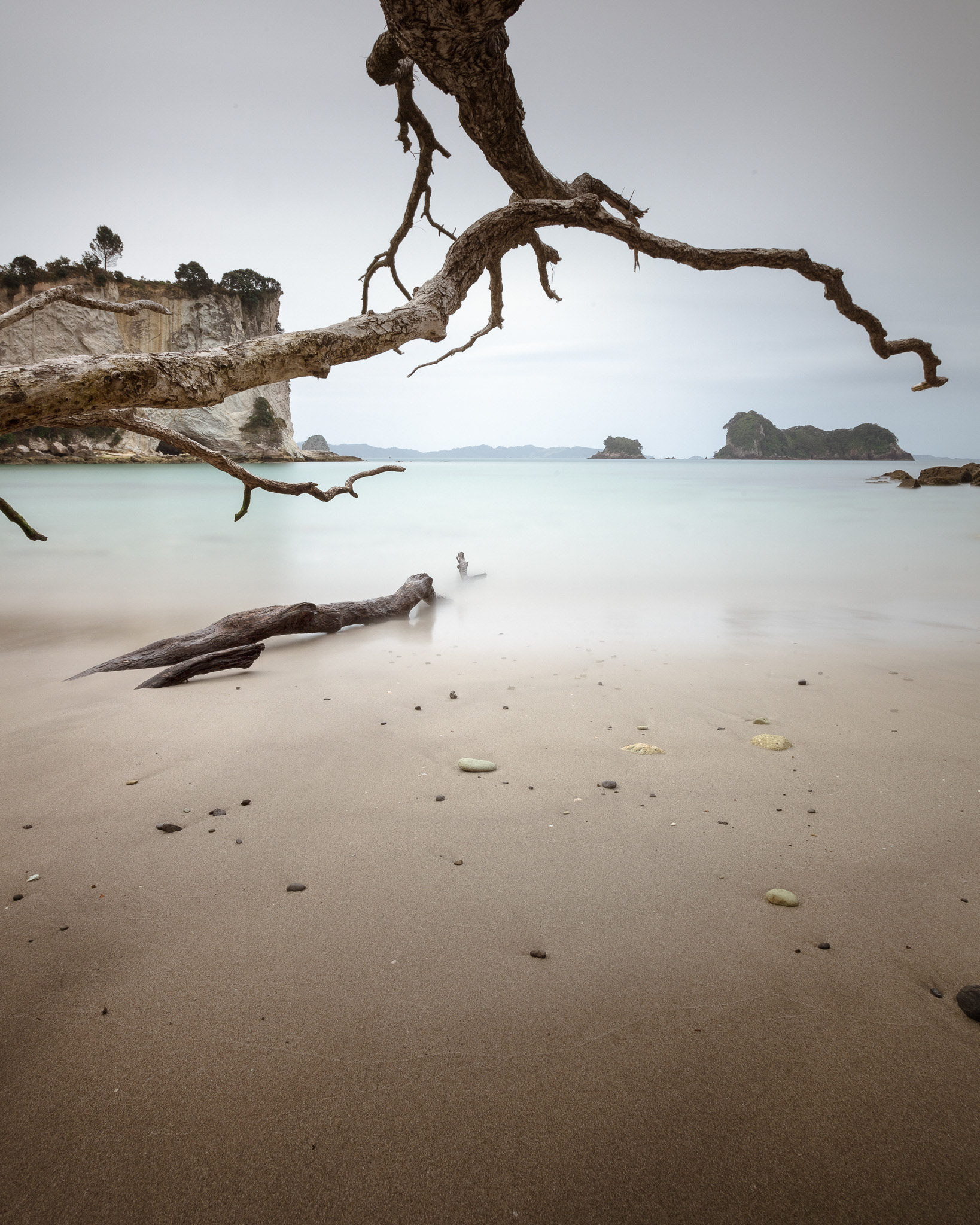
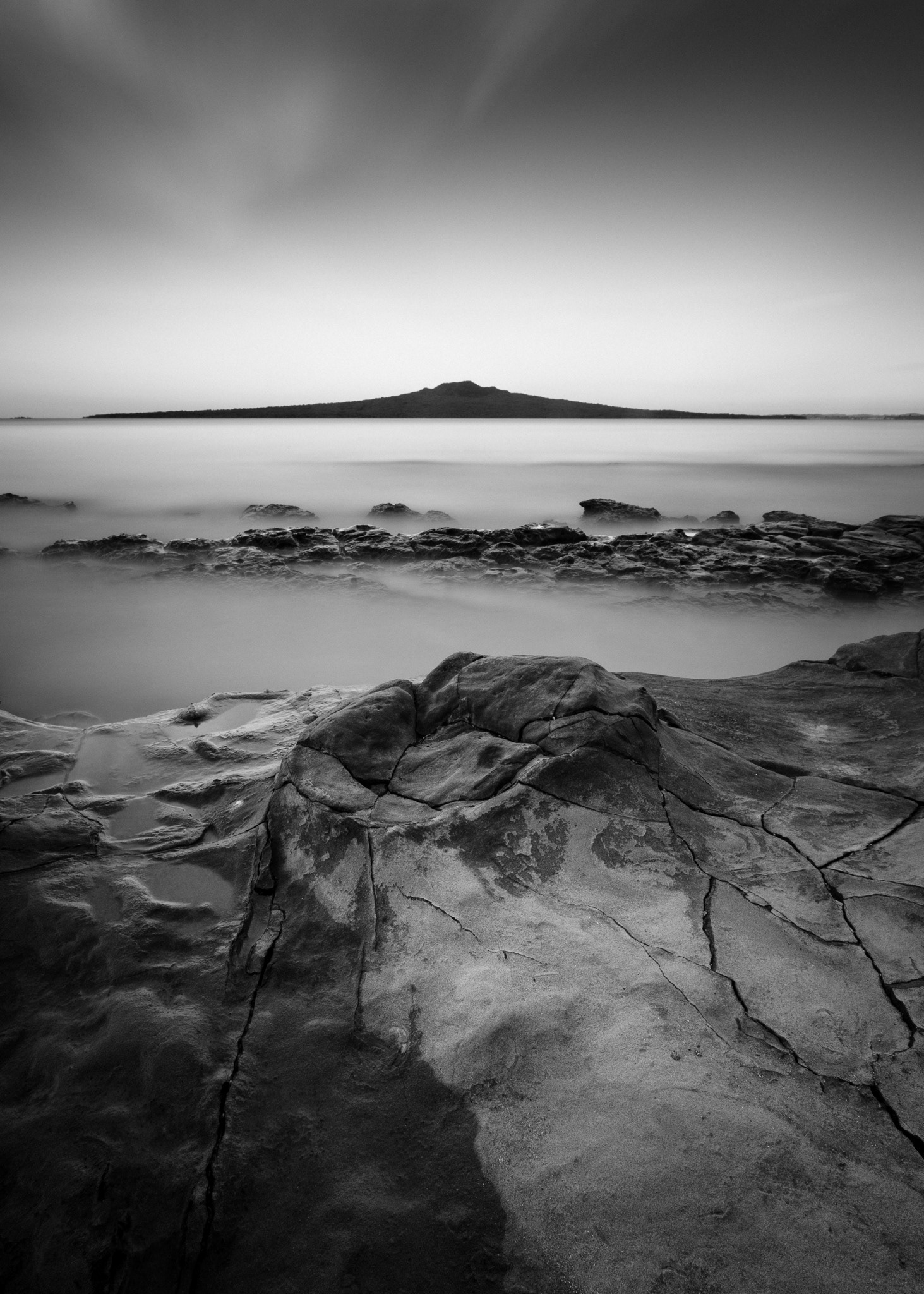
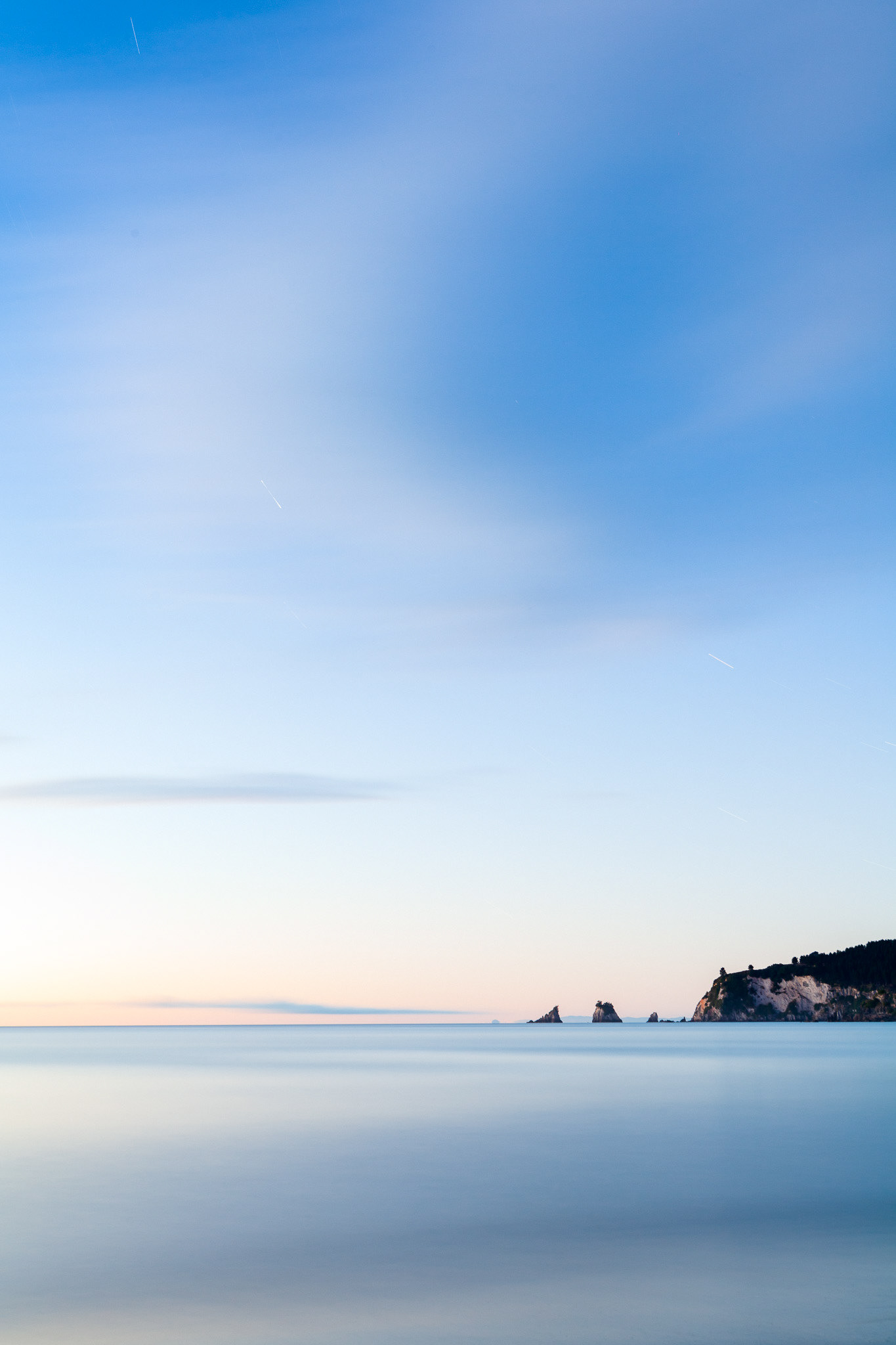
An eerie echo of the recent volcanic past emerges at low tide in front of Rangitoto, an extinct island volcano sitting in the Hauraki Gulf opposite Auckland.
Rangitoto last erupted only 600 years ago to create the island lying off the coast of Auckland. Its one of many extinct volcano’s in the surrounding area and the marks of early vulcanism lie all around. I’m not sure if the form revealed here at low tide is actually volcanic in nature but like the way it echoes Rangitoto’s summit crater.
122 second long exposure shot on a Canon EOS 5d MkII using a wide angle lens at 17mm and a 10 stop ND filter. Aperture F16, ISO 100. Processed for tone and colour in Lightroom 3.
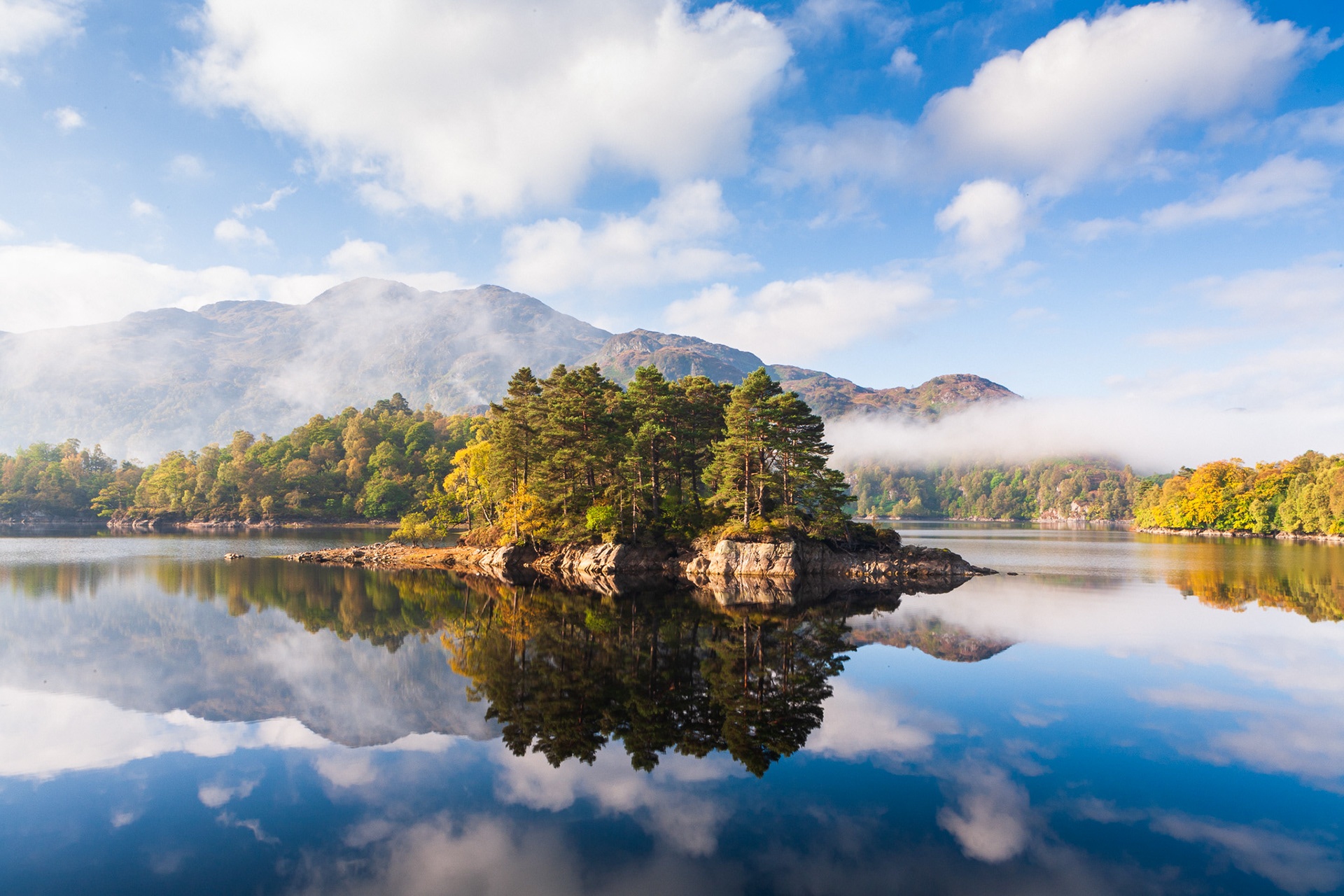
I never thought to be photographing this landscape floating so serenely between heaven and earth. The day had started so different with a heavy blanket of fog shrouding the loch I explored in an earlier post. The last thing I expected was this, almost exactly the conditions I’d hoped for as I set out before dawn. Fog lifts to reveal a scene of stunning clarity and calm. Streamers of mist floating up, burned off by strong sun breaking through to light the autumn colour of forest, island and mountain. White cloud speckled blue skies clear and reflect infinitely in the still mirror of Loch Katrine. A magical landscape transformed and soon gone with the slightest breath of wind to ripple the waters surface and the spell is broken.
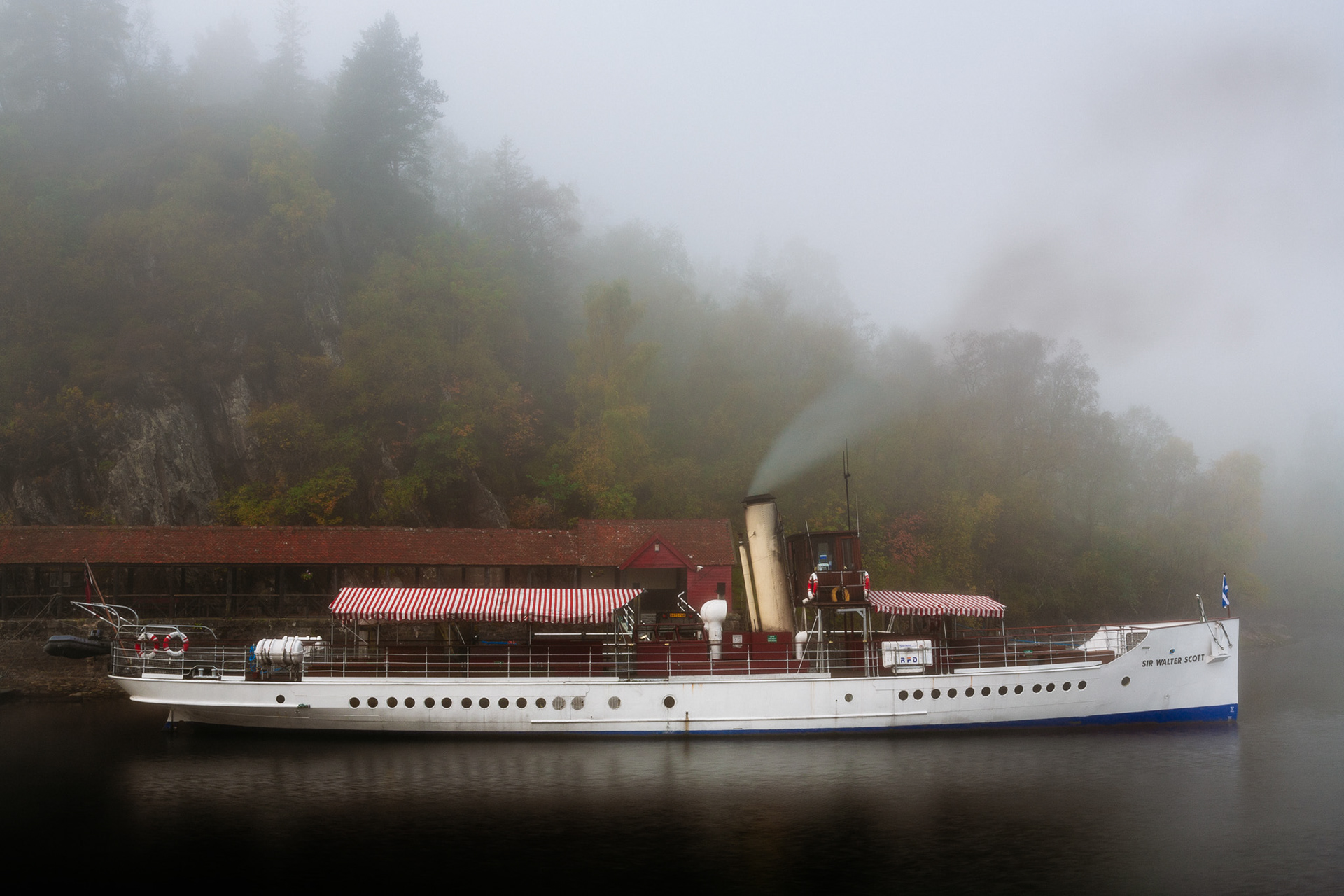
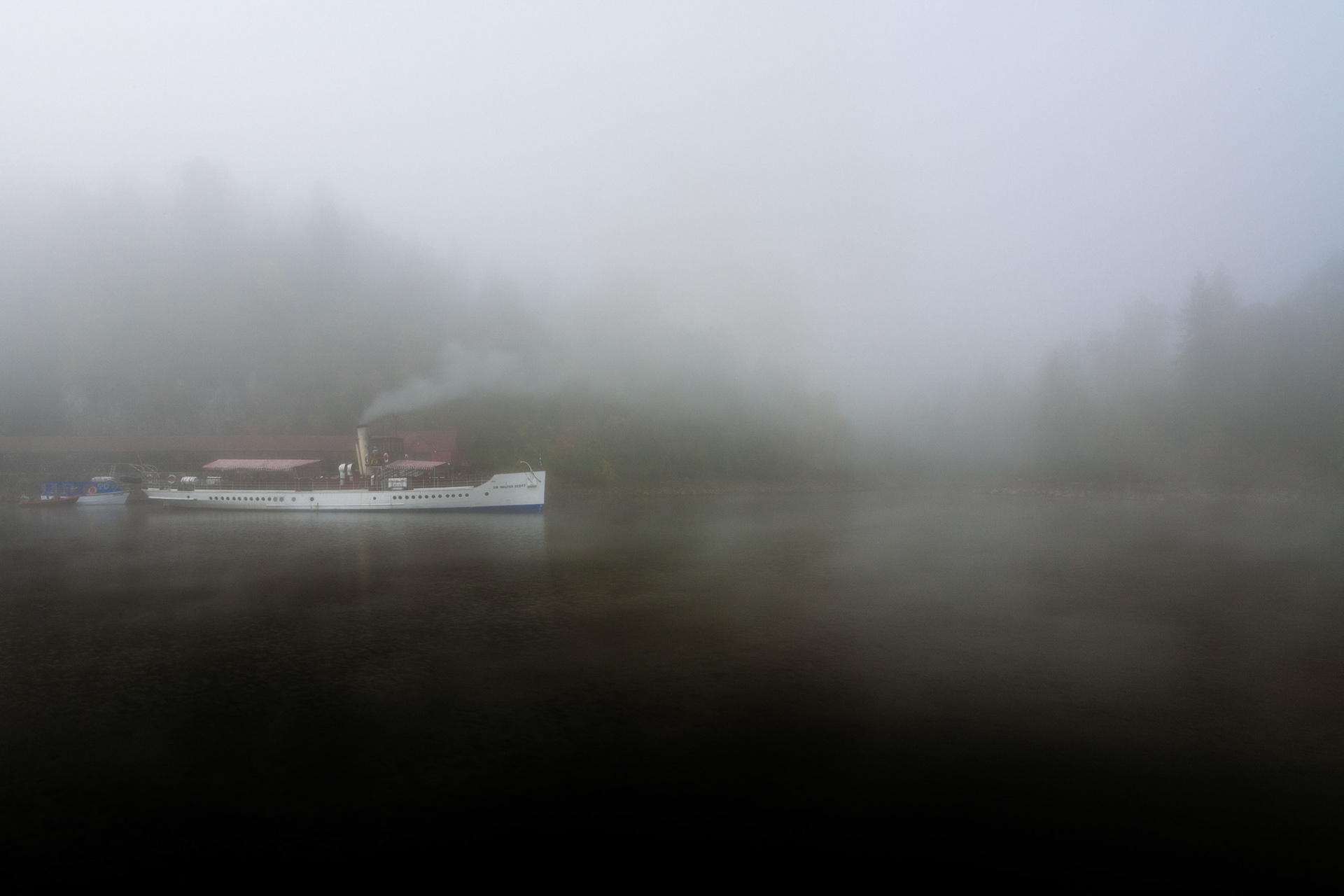
Earlier the same day, I shot a series of photographs of the steamship Sir Walter Scott making ready to sail in heavy fog amongst these islands. The contrast is quite incredible and I’m still blown away that conditions can change so dramatically in the space of a few hours.
Arriving early one morning, my plans to photograph some autumn colour at dawn amongst the woods and islands on Loch Katrine are derailed by heavy fog. Instead, I’m plunged bleary eyed and blinking into moody mists and shifting ghostly forms as the unexpected conditions demand a rapid rethink to the shoot.
Located some 30 miles north of Glasgow, Loch Katrine lies at the heart of the Loch Lomond and Trossachs National Park and, thanks to a remarkable piece of Victorian engineering, is also the city’s main water supply. To help maintain purity, boats are generally not allowed on the loch. However, the SS Sir Walter Scott has been sailing here for over a hundred years and still ferries tourists around this gem of a spot.
As the steamship makes ready to sail, smoke rises gently into the mist and makes for a great first subject on this atmospheric day. Berthed against a backdrop of rocky crags and woodland tinged with autumn, all colour is muted by the fog. A diffuse and uncertain glow pervades the greyness of the scene as the fog naturally desaturates the colour and flattens the contrast. The lack of any obvious modern appliance and the foggy conditions contribute an air of antique and timeless still. Some of the pictures could have been captured any time and remind me of landscapes by the artist JMW Turner. Not that I’m interested as such in emulating a painting, but feel their influence in some of my choices later in Lightroom as I began to push and play with the subtle atmospherics of light and colour.
I’ve desaturated some of the colour to help emphasise this antique feel while boosting others a little to strengthen their appeal. Some extra punch to the awnings by increasing the saturation in the reds. Some strength to the bowlines and eventual skies by reducing the luminosity to deepen the blues. Lightening the yellows and oranges to pull out the autumn colour. I’ve also played around with contrasts, strengthening the blacks to better delineate the forms without hopefully overly affecting the subtle mid tone atmospherics created by the fog.
As with many of these adjustments in Lightroom, once you begin getting one shot into shape the others quickly follow even as conditions and light changes. And change they did as the day wore on and some strong sun began pushing through and shift the fog to reveal a landscape of startling clarity and contrast. But more of that later.

Grey Shore, Loch na Keal
A subtle pink twilight creeps under low grey cloud to light the rocky shore of Loch na Keal, a sea loch on the Isle of Mull in Scotland’s Inner Hebrides.
Sometimes the weather on the Scottish islands changes real fast. And other times it just sets in, either way for weeks on end before breaking. An ever changing weather and light that strays or stays to lend a fascination to this ancient and beautiful landscape. These two photos were taken over the space of a few evenings in the Spring of 2009. Both revealing something of this shifting character, though Mull itself I suppose, never really changes. Not along this old shore anyway visited, perhaps by Viking raiders, pods of dolphin and occasional stray photographers in camper vans. What change the stepped basalt cliff, the broken teeth of skerries, the lone house in the distance? Imagining a slow grind of time across these islands isn’t hard. And neither is the dawning realisation of connections between landscapes. Each of the islands distinct, Mull, Rum, Skye, Harris, and the myriad others, so diverse but sharing, a history, a geology and familiarity formed, perhaps in the same moment stretching beyond Scotland to similar profiles in far off Iceland, the Faroes or even Greenland?
Spring Twilight, Loch na Keal
A clear and gentle twilight bathes the shores of Loch na Keal in glowing pastel shades on the Isle of Mull in Scotland’s Inner Hebrides
Grey Shore, Loch na Keal: photographed with a Canon 5d using the EF17-40mm L lens at 17mm, ISO 50, 30 seconds at F16. Processed in Lightroom for tone contrast and colour
Spring Twilight, Loch na Keal: photographed with a Canon 5d using the EF17-40mm L lens at 17mm, ISO 50 and bracketed together from three exposure each taken at 4, 15 and 30 seconds F14. Blended together in Lightroom using LR Enfuse and processed for tone, contrast and colour.
Ten Mile Sunset
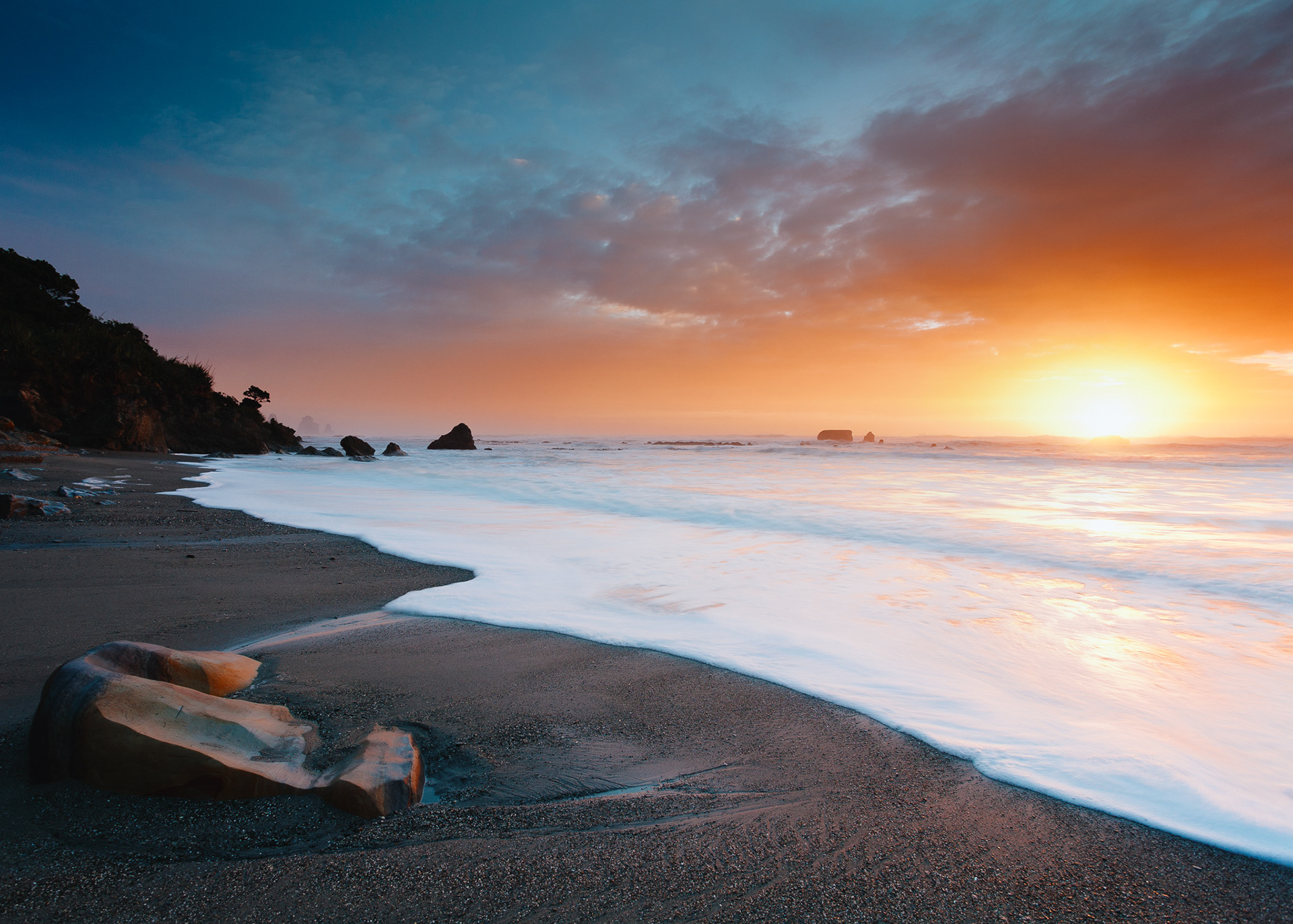
Stunning colour over the Tasman as the sun sets into the surf on the west coast of South Island New Zealand near Ten Mile Creek, Punakaiki.
After the gathering darkness of the last few photographs with their emphasis on moody volcanic landscapes I thought I’d repost this much more colourful picture taken a few years back out on the west coast of South Island near Punakaiki. I discovered the spot on my first foray out west during a visit to family in nearby Greymouth. Taken in mid July (mid Winter in the southern hemisphere) and extremely lucky with the light, I’m still blown away by the intensity of colour out over the Tasman sea. This was a big day out for me learning how to photograph the ocean down here and discovering that its very different in the way it moves compared to the seas I’m used to. More dangerous and unpredictable, capable of lulling into a false sense of security as I found out when coming close to losing my camera gear earlier that day as a rogue wave swept in from nowhere and engulfed me mid lens change. To this day, I don’t know how the open camera bag floated in front of me and didn’t immediately flood. But I did learn to respect the condition that each time you go near the sea here, your bag stays firmly strapped on and you stay ready to run.
About the photograph
This picture is a bracketed exposure across two separate exposures to compensate for the strong contrast between land and sky. Shot using a Canon 5d and EF 17-40mm f.4 L lens at 17mm, ISO50 at 0.8 and 1/5 of a second respectively and blended in Lightroom using LR Enfuse. Further processing and adjustment for tone and contrast applied in both Lightroom and Photoshop.
Volcanic Dyke, Kildonan
A spectacularly straight black basalt dyke stretches far offshore and into a stormy sea at Kildonan on the Isle of Arran, Scotland.
Yet another dark volcanic landscape photograph makes an appearance. This time, from way back home in Scotland and the Isle of Arran sitting in the Firth of Clyde. This black basalt dyke formed when lava cooled in some long distant crack, best estimates, when the Atlantic began to open up some 130 million years ago, according to wikipedia but then I’m no geologist! Massive volcanoes erupted all along what is now the west coast of Scotland and formed much of the ancient landscape and today’s highlands and islands, remnants of a mountain chain truly Himalayan in size. And that’s young! We got rocks in Scotland dating back to some of the oldest on the planet, close in fact to the very beginning. So its interesting to make this comparison with my new home in New Zealand and the landscape I’m exploring around Auckland, formed, quite literally, yesterday but also, sometimes, so similar in feel. It is often said that New Zealand is very like Scotland. From what I’ve seen so far, it is and it isn’t and Scotland remains one of the most stunningly beautiful and diverse landscapes I’ve yet to see. Now I’m sounding homesick!
About the photograph
This picture was shot using a Canon 5d and EF 17-40mm f.4 L lens at 17mm, ISO100 and 120 seconds shutter at f16 with a circular polarising filter on the lens. The photo was processed in Lightroom with some adjustments to tone, contrast and saturation to emphasise the darkness of mood I wanted the shot to express.
Lava Bombs, Bethell’s Beach
Basalt boulders and pumice stone stand embedded in columns of volcanic ash turned to concrete before the wide expanse of raging surf on Bethell’s Beach near Auckland, New Zealand.
I don’t know if these are lava bombs. But when you find these basalt boulders and pumice stones embedded like this in columns of solidified volcanic ash hard as concrete, you begin to wonder. Of course the columns themselves are carved by the raging surf out here on Auckland’s west coast. But somehow, sitting here waiting for the long exposure to complete, I can’t help but imagine these raining down into the ash layer, compressing the column beneath and making it resist the seas a little longer these million(?) years later. Though its probably more like hundreds of thousands or less as I discover exploring more of this new land. That’s my theory anyway, but if any geologist would care to comment I’d be keen to find out more. Actually these rocks reminded me of home. In particular the rocks found in the Western Isles of Scotland, again all formed by vulcanism when the Atlantic opened up and America split off from Europe. The rocks there are gabbro and have this curious quality that you stick to them. Fantastic to walk and climb on because the grip is so strong. These boulders had similar qualities, possibly formed in similar ways but interesting to me to literally feel with my hands and through my boots that connection to home so far away.
About the photograph
This picture was shot using a Canon 5d Mark II and EF24-70mm f2.8 L lens at 25mm, ISO 100 at f18. Its a bracketed exposure across three shots, each taken with a 10 stop neutral density filter over the lens to slow the camera down. Each exposure measured 30, 60 and 120 seconds consecutively and was blended in Lightroom using LR Enfuse. Some further processing and tonal adjustment was also done if Lightroom.
The Basalt Forest, Takapuna
Photographed with a Canon 5d MkII using the EF17-40mm f4 L lens at 17mm for 16 minutes at f5.6, ISO 400
I’ve been drawn back now on a number of occasions to explore this location on the shore by Takapuna in Auckland. For one thing, its relatively close to where I live, an easy enough 6 or 7 km cycle and is proving just one of those places you develop an endless fascination for. On the horizon, ringed with red and green navigation lights lies the island of Rangitoto meaning ‘bloody sky’ and indicating perhaps its creation witnessed some 600 years ago by local Maori. Tree covered, uninhabited and protected as a nature reserve, the island spreads out around the extinct volcano that forms its highest point. This volcanic theme continues on the basalt shore at Takapuna, the result of a much older eruption some 1 – 200,000 years ago when lava flowed out from what is now Lake Pupuke lying a kilometre or so behind us inland. This lava flow engulfed a forest of Kauri trees trapping and encasing some in stone which then burned or rotted out from within to leave a collection of circular stone pillars and casts like the one above. Others formed arches and tunnels as fallen boughs and trunks were swept along and moulded in the rapidly cooling stone to form a unique coastal feature. A basalt lava pavement, broken, eroded and downright weird.
I returned here to put into practice some of the things I’ve been learning about night photography and take some of the longest exposures I’ve yet tried. The two shots below measure in at 32 minutes each while to one above is a 16 minute exposure. A lot can happen in 32 minutes. The tide comes in quite a long way in that time and what started out as dry land became ankle deep in sea water by the end of the exposure. I think that’s why I switched my last shot of the evening down to 16 minutes, sacrificing some depth of field and length of star trail for the sake dry feet on the ride home! )
The Basalt Forest II, Takapuna
Photographed with a Canon 5d MkII using the EF17-40mm f4 L lens at 22mm for 32 minutes at f8, ISO 400
Over the course of the evening I’m realising that with this type of photography you enter a very different space than usual and begin to enjoy the slow pace that evolves around the shoot. I imagine its a lot like night fishing and its quite contemplative to be out there on the one spot for such long periods of time. You start becoming acutely aware of your surroundings as your night vision develops and you tune into the sights, sounds and smells of where you are. Water and sea salt on the air, fragrant plants and trees on the breeze, waves splashing by the shore, a ship engine in the distance and a growing awareness of time passing, an enjoyment of watching the world go by. There’s also the realisation that you are actually recording the process of time itself passing and creating an abstraction that is less a snapshot and more a long cool stare. And once you get the exposure nailed and control these in a measured way, you start playing around with stretching and compressing time as part of the shoot itself. Star trails being the classic example I suppose. But also, the slow motion of the tide coming in or clouds floating by compressed and stretched in the frame. All this adds to a kind of weird surrealism that long exposure photography opens up. A slightly different perspective and shift that as well as photographing light we are also capturing time. Perhaps not unlike these ancient lava flows that captured Kauri trees, or formed an island in the geological blink of an eye.
That Sinking Feeling
The last shot is another 32 minute exposure and records another type of motion as the tripod slowly sinks into the sand by a few millimetres and ruins the shot. A pity really as I quite liked the composition of foreground rocks. Of course, the purist in me could lay claim that this also captures something of the process in the moment, but I’ll draw the line there! )
Falloch Falls, Early Autumn
The Falls of Falloch, a pretty highland river flows down a woodland gorge to the north of Loch Lomond, Scotland
I shot this waterfall on a typically dull and driech autumn day where the low light helped extend the exposure time out and allow for the creation of these delicate ribbons of water. I must have been working without my remote cable release which explains the 30 sec exposure. The trick here is to fire the shutter using the timer set to 10 seconds. This allows for any vibration to die down before the shutter fires. At f14, the lens has given a beautiful sharpness and depth to the scene. I particularly like the contrast this creates between the detail of the surrounding rocks and the ethereal almost ghostly quality of the water flowing through the gorge. One of my favourite waterfall shots from an easily accessible spot that I’ve visited on a number of occasions and lying just off the main A82 road north of Loch Lomond. If passing, I’ll usually drop in to check it out, particularly after rain when the waters are high.
Photographed with a Canon EOS 5d and EF17-40mm lens at 17mm with circular polarising filter. Aperture at F14, ISO 50 and 30 second shutter speed. Processed in Adobe Lightroom 3 with minimal retouching in Photoshop CS5.